Six Ancient Kilns of Japan
Tokoname, Aichi
Tokoname ware has been made since the late Heian period in Tokoname, Aichi Prefecture, on the west coast of the Chita Peninsula, and is the largest of the Six Ancient Kilns of Japan. Shipped by sea across the country, it also influenced other centres such as Shigaraki and Echizen. Drawing on the official Six Ancient Kilns materials, this page outlines how Tokoname ware developed and what sets its clay and techniques apart, along with the Tokoname-connected potters, exhibitions and shops that megu knows about.

Tokoname ware descends from the Sanage kilns and began in the late Heian period, around 1100, when kilns were built in the hills of the Chita Peninsula. These were simple anagama tunnel kilns dug into slopes; there are said to have been more than 3,000 of them across the peninsula. They fired bowls, basins, jars and large storage jars, and by the Kamakura period large jars and vats of more than 50cm were being made. Used to store sake and oil and for indigo dyeing, they were carried by ship and have been found at sites across Japan, including Hiraizumi, Kamakura, Kyoto, Sakai, Hakata and Dazaifu.
The anagama declined sharply from around the Nanboku-cho period, and by the Muromachi period kilns survived only in the old town of Tokoname. In the 15th century they were improved into semi-underground ogama, and in the Tenpo era of the late Edo period the multi-chamber climbing kiln was introduced.
Teapots (kyusu) appeared in the late Edo period with the spread of sencha tea. In the Tenpo era the second-generation Ina Chozo developed a technique of firing white-clay pots with seaweed laid on them, and in 1854 Sugie Jumondo completed the red-clay shudei teapot, modelled on the zisha ware of Yixing in China. In the Meiji era clay drainpipes were developed under Koie Hoju for the new sewer systems, and in the Taisho era Tokoname fired the tiles and terracotta that clad Frank Lloyd Wright's Imperial Hotel, which can be seen today at the Meiji-mura museum.

Tokoname's fine clay comes from the sediments of Lake Tokai, which between about 6.5 and 1 million years ago stretched from southern Gifu across Owari to the Suzuka area. It is rich in iron and fires hard even at relatively low temperatures, which makes it well suited to large pieces.
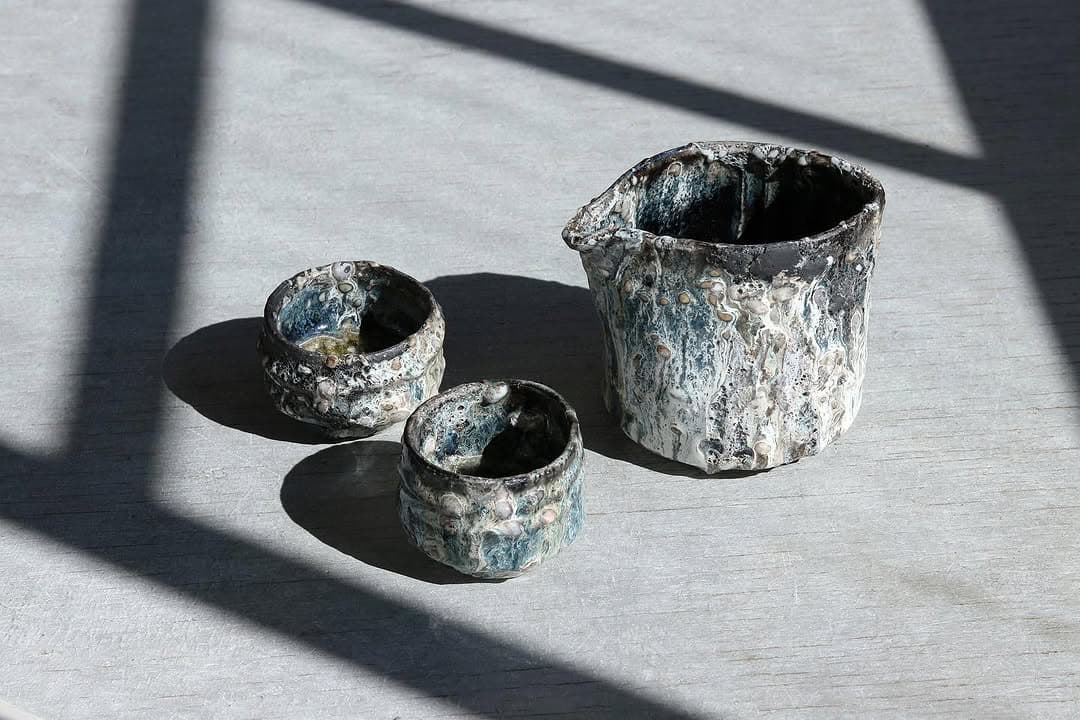
Although it shares Seto's descent from the Sanage kilns, Tokoname has continued as yakishime — unglazed, hard-fired ware. In the late Heian period potters developed yoriko-zukuri: carrying a coil of clay 7–10cm thick over the shoulder, the potter walks around the jar, building it up as if he himself were the wheel. The technique is still practised today. The large storage jars made here continuously since the late Heian period have changed in the shape of their rims and in their overall form over the centuries.
Tokoname is now known for teapots and maneki-neko beckoning cats, but these are relatively recent; the town has always produced whatever each era needed. When you pick up a piece, look at the hard-fired clay surface — and, with shudei ware, at the colour of the clay itself.

The Six Ancient Kilns of Japan (Nihon Rokkoyo) is the collective name for six representative pottery-producing areas whose production has continued from the medieval period to the present day: Echizen, Seto, Tokoname, Shigaraki, Tamba and Bizen. The name was coined around 1948 by the ceramics scholar Fujio Koyama, and in 2017 the six were recognised together as a Japan Heritage under the story "Kitto Koisuru Rokkoyo" (roughly, "You're sure to fall for the Six Ancient Kilns: pottery towns born and raised in Japan").
Of the six, only Seto made glazed ware; the other five are known for yakishime — unglazed stoneware fired hard at high temperatures.
29 people. Potters who have exhibited at a shop or gallery in Tokoname, or whose profile mentions Tokoname. This is not a complete list of the area's potters.
Sources